

Subtotal $0.00
 24 Hour Emergency Aid
Kidney stones rarely announce themselves gently. One day you feel completely normal, and the next you’re doubled over with a pain unlike anything you’ve felt before. Yet not every kidney stone behaves this way – some sit quietly in the kidney for months without a single symptom, only to be discovered by accident during a routine scan.
This is exactly what makes kidney stones tricky. Knowing which symptoms matter, and when a symptom stops being “something to watch” and becomes “something to act on,” can spare you unnecessary pain, prevent kidney damage, and in some cases, avoid a medical emergency.
Below are the 10 symptoms every adult should recognise, followed by clear guidance on when it’s time to stop waiting and book an appointment with a urologist.
What Exactly Is a Kidney Stone?
A kidney stone (medically called a renal calculus) is a hard deposit made of minerals and salts – most commonly calcium oxalate, uric acid, struvite, or cystine – that forms inside the kidney when urine becomes too concentrated.
According to the National Institute of Diabetes and Digestive and Kidney Diseases (NIDDK), a small stone may pass through the urinary tract on its own with little or no pain, while a larger stone can get stuck and block the flow of urine – which is when severe pain or bleeding typically begins.
The National Kidney Foundation notes that stone size varies enormously – from a grain of sand to, in rare cases, the size of a golf ball – and as a general rule, the larger the stone, the more noticeable the symptoms.
10 Common Kidney Stone Symptoms and Warning Signs
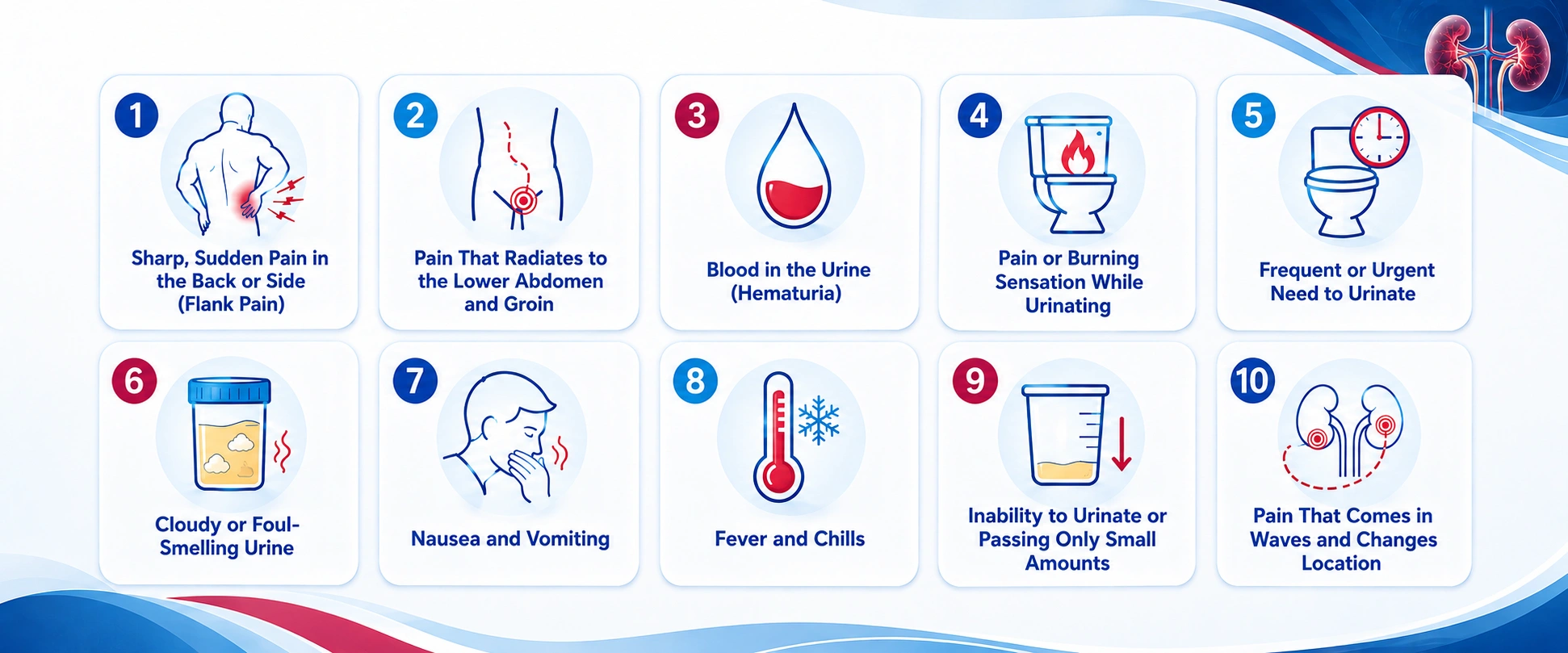
Kidney stone symptoms can vary widely from one person to the next, depending on the size of the stone, its exact location, and whether it’s moving through the urinary tract or sitting still. Some people feel nothing at all until a routine scan picks up a stone by chance, while others land in the emergency room within hours of their first twinge of pain. Here are the 10 symptoms that show up most often, and what each one usually means.
1. Sharp, Sudden Pain in the Back or Side (Flank Pain)
The hallmark symptom of a kidney stone is a sharp, cramping pain that starts suddenly below the ribs, in the back or side. This is often called renal colic. Unlike muscular back pain, this pain tends to come in waves – intensifying, easing slightly, and then surging again as the stone moves and the ureter spasms around it.
2. Pain That Radiates to the Lower Abdomen and Groin
As the stone travels down the ureter toward the bladder, the pain often shifts location – moving from the back toward the lower abdomen, groin, and in men, the testicles. This happens because the kidney and ureter share nerve pathways with these areas, so the brain interprets the pain as coming from a wider region than just the kidney itself.
3. Blood in the Urine (Hematuria)
Pink, red, or brown-tinged urine is one of the most common and important warning signs of a kidney stone. The NIDDK lists hematuria as a primary symptom – it happens when a sharp-edged stone scrapes the lining of the urinary tract as it moves. Even a small amount of blood, sometimes visible only under a lab test, should be evaluated promptly.
4. Pain or Burning Sensation While Urinating
As a stone approaches the bladder, it can irritate the urinary tract lining, causing a burning sensation similar to a urinary tract infection (UTI). This symptom is frequently mistaken for a routine UTI, which is why a proper diagnostic evaluation matters – treating the wrong condition delays real relief.
5. Frequent or Urgent Need to Urinate
A stone sitting near the bladder can create a constant urge to urinate, even when very little urine is actually passed. This “constant need to urinate” is specifically flagged by the NIDDK as a classic kidney stone symptom, distinct from normal frequent urination caused by fluid intake.
6. Cloudy or Foul-Smelling Urine
Cloudy or unusually strong-smelling urine can indicate that a stone is present alongside a urinary infection. This combination needs urgent attention, because infection trapped behind a blocked stone can escalate quickly.
7. Nausea and Vomiting
The kidneys, ureters, and digestive tract share overlapping nerve connections. When a stone causes intense pain, this can trigger the body’s autonomic nervous system, resulting in nausea and vomiting – sometimes severe enough to cause dehydration, which in turn makes it harder for the body to pass the stone naturally.
8. Fever and Chills
Fever accompanying kidney stone pain is one of the most important red-flag symptoms on this list. It usually signals that an infection has developed behind the blocked stone. Left untreated, this can progress to a kidney infection (pyelonephritis) or, in serious cases, a bloodstream infection known as urosepsis – a medical emergency.
9. Inability to Urinate or Passing Only Small Amounts
If a stone fully blocks the ureter – or if stones are present on both sides – urine can back up into the kidney, a condition called hydronephrosis. Inability to urinate despite feeling the urge is a serious symptom that requires same-day medical evaluation.
10. Pain That Comes in Waves and Changes Location
Many patients describe kidney stone pain as unpredictable – intense for 20–60 minutes, followed by a temporary lull, then returning just as sharply. This wave-like pattern, combined with pain that shifts from the back to the front as the stone moves through the urinary tract, is a strong indicator that a stone – rather than a muscular or digestive issue – is the underlying cause.
| Good to know: Not every kidney stone causes symptoms. Small stones, especially those under 4–5 mm, can sit in the kidney or pass through the urinary tract with little to no discomfort. This is why some stones are only discovered incidentally during an ultrasound or CT scan done for an unrelated reason.
When Should You See a Urologist?
Occasional mild back discomfort doesn’t always need a same-day appointment. But certain combinations of symptoms mean you should not wait. See a urologist promptly – or head to an emergency department – if you notice any of the following:
- Severe pain that doesn’t ease with rest or over-the-counter pain relief
- Visible blood in your urine
- Fever above 101°F (38.3°C) or chills alongside stone symptoms – this combination can indicate an infection trapped behind a blocked stone, which can progress rapidly if untreated
- Persistent vomiting that prevents you from staying hydrated
- Inability to urinate, or urinating only in small, painful amounts
- Pain lasting more than a few hours without improvement
- A known kidney stone with worsening symptoms, even if it was previously “just being monitored”
- Recurrent kidney stones – if this isn’t your first stone, a urologist can investigate the underlying metabolic cause and help prevent future episodes
As a general clinical guideline echoed across urology practice, fever combined with a suspected kidney stone should always be treated as urgent, since infection behind a urinary blockage can escalate to a serious condition within hours rather than days.
Why Early Evaluation Matters in Kidney Stone Treatments

Delaying treatment doesn’t just prolong pain – it can lead to complications:
- Kidney damage from prolonged blockage and pressure build-up
- Recurrent infections if the underlying stone isn’t cleared
- Larger, harder-to-treat stones, since stones tend to grow over time if the underlying cause isn’t addressed
- Emergency hospitalisation, which is almost always more disruptive and costly than a planned, minimally invasive procedure
A urologist can confirm a kidney stone diagnosis through a combination of your symptoms, urine tests, blood tests, and imaging (ultrasound or CT scan), and then recommend the right course of action – from simple hydration and monitoring for small stones, to laser or minimally invasive procedures for larger or obstructing stones.
How Kidney Stones Are Typically Treated
Depending on the size, location, and composition of the stone, treatment options generally include:
- Conservative management – increased fluid intake, pain relief, and medication to help a small stone pass naturally
- Medical expulsive therapy – medication that relaxes the ureter to ease stone passage
- Laser stone surgery (RIRS/URS) – a minimally invasive procedure using a laser to break the stone into fragments that pass naturally
- PCNL (Percutaneous Nephrolithotomy) – used for larger, complex stones
- Shock wave lithotripsy (ESWL) – non-invasive sound waves used to fragment certain stones
Your urologist will determine the right approach based on stone size, location, your kidney function, and whether infection is present.
Get Expert Kidney Stone Care at Vivanta – The Kidney & Surgical Hospital, Surat
If you’re experiencing any of the symptoms above, don’t wait for the pain to become unbearable. At Vivanta – The Kidney & Surgical Hospital, Surat, our team led by senior consultant urologist Dr Sagar Katudiya specialises in the diagnosis and treatment of kidney stones using advanced Green Light Thulium laser technology and minimally invasive laparoscopic techniques – offering less pain, faster recovery, and fewer complications.
With over 20,000 successful procedures, 24×7 emergency urology care, NABH-certified safety standards, and a completely cashless treatment facility, Vivanta is trusted across Surat and Gujarat for kidney stone, prostate, and complete urological care – for patients of every age, from infants to seniors.
Experiencing kidney stone symptoms? Book a consultation with our specialists today, or call us directly for 24×7 emergency support: +91 94272 65827 / +91 90990 67657.
Learn more about our Kidney Stone Treatment services or contact us for a second opinion before any surgical decision.